Showing posts with label emt. Show all posts

Monday, May 12, 2014

Firefighter Workouts on Shift-- To workout or not?

Do you workout on shift?  Should you workout on shift and what is the best workout to perform?

This is a major concern for the fire rescue athlete.  On one hand we know we should be working out to stay and get fit for duty. Yet , if we burn out in the gym we won't be able to perform when it really matters. I recently posted an interval workout (Click Here to Read it) that received a lot of hits and emails. Most of the emails dealt with this question more importantly asked "what is the best form of exercise to perform on duty?"

Here is my take on the question.  We all know that when the bell goes off the fire rescue athlete MUST be ready to perform.  With that in mind, it doesn't make a lot of sense to perform a grueling workout on duty.   I personally prefer some lighter cardio interval training, some core and/or rehab exercisesfoam rolling, and stretching.

One of the benefits of being a firefighter is that (for the most part) we know our schedules well in advance and should plan our more intense workouts for off-duty days and save the on-duty days to recover from them.   This requires some planning but is the most effective way to be "fit for duty."

Here is a great example of a "planned"  week of workouts for the fire rescue athlete.  This is similar to the weekly schedule found in the FRF Ultimate Fire Rescue Athlete Program.

Sunday
Fullbody Strength or Metabolic Workout- This type of workout challenges all muscle groups including the core.  Metabolic workout has short intervals and more power movements, strength workouts utilize longer rest intervals and heavier resistances.

Monday
Cardiovascular Interval Training-  Higher intensity cardio workout like sprints, hills or FRF Interval

Tuesday
Firehouse Shift- Foam rolling and light stretching between calls

Wednesday
Fullbody Strength or Metabolic Workout- This type of workout challenges all muscle groups including the core. Metabolic workout has short intervals and more power movements, strength workouts utilize longer rest intervals and heavier resistances.

Thursday
Firehouse Shift- Recovery day, maybe some foam rolling and/or stretching

Friday
Day OFF- This is a great day to take a day off, especially if you had a tough shift the night before

Saturday
Firehouse Shift- Cardio Interval and foam rolling, possibly some fire-ground circuits.

Sunday
Fullbody Strength or Metabolic Workout- This type of workout challenges all muscle groups including the core. Metabolic workout has short intervals and more power movements, strength workouts utilize longer rest intervals and heavier resistances.

Obviously everyone's schedule is a little different, I included the following Sunday to set up the next week where you may not have as many shifts.  The main idea is to plan your workouts to help you continue to work towards your fitness goal and to "be ready" on-shift.

If you are currently spinning your wheels about your workout plan or are looking for a new plan?  Take a look at the FRF Ultimate Fire Athlete Workout...I think it is the most efficient and effective workout for fire rescue athletes.

Please leave some comments and as always email me with questions. 
Stay Safe and Healthy,
A. Zamzow

Sunday, August 18, 2013

Essential Components of a Fire Rescue Fitness Program....revisited.

This is a re-post of one of my more popular articles that needs to be emphasized. Without proper planning, your fitness program may actually be setting you up for failure.  Read the article below...how does your current fitness program measure up?

This blog topic is one near and dear to my heart and your career--Workouts for Fire Rescue Athletes. Over the last couple of months I've been writing about some of the more popular workouts seen in firehouses across the world. You can read about them here and here or listen to a great radio interview about this topic HERE

I've received a ton of feedback about those articles both good and bad. One thing I have not done yet is to answer the highly debated question...."What is the best workout for Firefighters, EMTs and Paramedics (Fire Rescue Athletes)?  More importantly what are the components of the best Fire Rescue Athlete Workouts? 

Without further delay, here is my answer (drum roll please)....

There is no single perfect program for fire rescue athletes. We all know we work in very uncertain situations and circumstances so we have to be ready for almost anything and no single workout program can prepare you for that.  There are some common components though that every fire rescue athlete should think about when evaluating a workout program. 

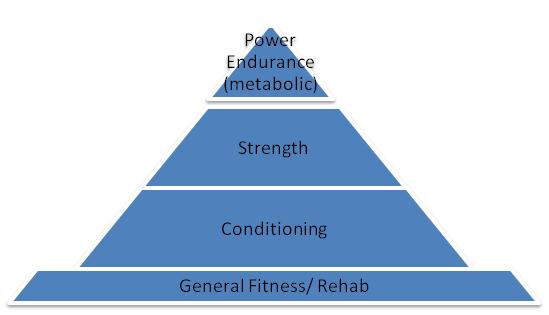
1.   The program must be planned using sound periodization and science. Training should follow a developmental approach or progression. This means there should be a hierarchy of training. First, it is essential for the fire rescue athlete to develop a training base that should increase the body’s functional capacity. Once this is accomplished, the intensity of the exercise is increased to emphasize strength and muscular development. In more general terms, we can also say we develop stability, then strength, and finally power. Regardless of what the training program looks like, it cannot violate this developmental approach. This is one variable that CrossFit does not do, people are getting injured from performing too many presses or pulls or jumps without having a sound base.


2.    The program MUST place a large amount of focus on Core Strength and Balance. During the course of their career, almost 50% of all fire rescue athletes will hurt their back while on duty. Low back pain is the number one reason firefighters retire early. In order for a program to be effective, it must utilize exercises that focus on the developing the glutes, shoulder girdle, hamstrings, hips and abs. Notice that I didn't say anything about a "six pack" of abs. That is one of the cons of P90X; the program is more concerned about beach muscle than core strength.

3.    The program needs to focus on cardiovascular conditioning and recovery.  When you think of cardiovascular conditioning most people think of running or biking, which in most cases emphasizes aerobic conditioning.  Fire Rescue athletes need to have a good level of aerobic fitness but cannot overlook the value of challenging the anaerobic systems.  If you've ever humped a "charged" hose line up some stairs or dragged a victim or axed a roof open you realized the importance of anaerobic fitness.  An effective Fire Rescue fitness program will set a good cardiovascular base then challenge the cardiovascular system with intervals.  Intervals are one of the best ways to simulate the high level of fitness required on the fire ground (click here for a great interval program).  

4.  The program must (at some point) contain full-body functional strength exercises.  Functional strength exercises increase balance around the joints and helps prevent injuries by stimulating stabilizing muscles.  Functional training is in essence is a full-body approach to core training and are effective in athletic injury rehab and prevention.   Functional strength movements like the push-up, goblet squat, lunge, pull-up strengthen all joints of the body in numerous planes.

5. Programs must include an Active warm-up and flexibility training. The warm-ups prepare the body for movement, boosts heart rate, blood flow to the muscles, and core temperature. These movements also improve the function of your nervous system. Think of this component as taking a few minutes to warm-up a car that has been sitting outside in cold temperatures all night. The main goal of this the active warm-up and flexibility component is to improve the long-term mobility and flexibility of your muscles. The more flexible the muscle and joint around the muscle; the better the fire rescue athlete recovers and the less chance of injury.

This is not an all encompassing list but it will definitely give you enough information to help decide if a program has what it takes to be effective for the fire rescue athlete. Take a look at your current program and see if it contains these components...if not, CLICK HERE to get a FREE Fire Rescue Fitness Workout that does.

Monday, March 5, 2012

Components of a Firefighter Fitness Program

I often get asked by Firefighters, EMTs and Paramedics to evaluate their current fitness programs and to possibly give some suggestions.  I try to explain to the individual or group that in order to evaluate the program we must understand the physical demands of the job.

Research conducted by York University (Ontario) about the physical demands of Firefighting stated-- The most commonly encountered applications of strength and endurance were lifting and carrying objects (up to 80 lbs), pulling objects (up to 135 lbs), and working with objects in front of the body (up to 125 lbs). The most demanding firefighting operations required a mean VO2 of 41.5 ml/kg.min-1 with peak lactate concentrations of 6 to 13.2 mM. Ninety percent of the demanding firefighting operations that were studied required a mean VO2 of 23 ml/kg.min-1. These aerobic energy requirements corresponded to 85 and 50% VO2max, respectively. Therefore a minimum VO2max standard for firefighter applicants of 45 ml/kg.min-1 is recommended.


In layman’s terms it means this...Firefighters need to be ready for almost any event. They need to routinely carry loads of 50 to 100 pounds, climb stairs and ladders, swing heavy mallets and axes, drag heavy objects, hold, hoist and stabilize hose lines. They must also be able to recover quickly from these tasks and perform such activities for prolonged periods of time. Lets not forget that all these actions are routinely done in awkward positions and sometimes on unstable planes.

So how do you translate those demands into a fitness program?

If you look at the above demands, tops on that list would be the emphasis on cardiovascular conditioning and recovery, next would be core strength and endurance to be able to carry the heavy weights in awkward positions, then you look at overall muscular strength and muscular endurance, flexibility and recovery. So basically, we need a functional fitness program that emphasizes circuit training, core training, balance and agility, joint flexibility, overall strength and endurance and must do this progressively to insure proper form and injury prevention. Doesn’t sound like your routine fitness program now does it?

Are you currently working out or need a program to get you back on track?  Download the FREE FireRescueFitness 28-day Quickstart Program and get "Fit for Duty." 


Source

Gledhill, N. and Jamnik, VK.  (September, 1992).  Characterization of the physical demands of firefighting. Can J Sport Sci. 17(3):207-13.

Saturday, February 4, 2012

Core Training for Firefighters, EMTs and Paramedics

          FireRescue athletes are at a very high risk of back injury as a matter of fact almost 50% of all firefighters will experience some type of back injury during their career.  Effective core training brings about a proactive approach to protecting your body and joints (especially your back) from injury. Core strength consists of hip, shoulder, and trunk stability. It is the foundation of efficient movement and vital to optimizing performance and your career as a FireRescue athlete.

          When should we work our "core" and how often.   In my
FREE 28-day Quickstart program I recommend performing your core  routine after an active warm-up.  This should occur towards the beginning of the workout...Why?  Because its easier to skip if you leave it to the end of the workout.  I know, I've been there, you do your strength training, maybe a little cardio then 'promise" that you would do some core exercises at home (or the next day).  


The Video below demonstrates 4 basic core movements that all Firefighters, EMTs and Paramedics should be able to do (or incorporate) into their workout.  Give them a try. 

Tuesday, January 31, 2012

10-minute Interval Overhauls (Firefighter Skills Training)

Now, as you probably know from reading my previous blog posts that I think that interval training is very applicable to what we do on the fire ground.  A unique component that I've added to my workouts is a 10-minute Interval Overhaul.  These interval Overhauls are a combination of exercises that challenges the total body, allows me to work on firefighter skills and simulates work on the fire ground.    And they really "jack-up" my metabolism too!   I challenge you to try one at the end of your workout.
Here is an example of an Overhaul I did after my strength workout the other day:
Sledge o’ matic- For this Overhaul finisher you need a sledge (the heavier, the harder), an old tire, some heavy dumbbells (or saws from the truck) and an interval timer set to 30 seconds of work and 30 seconds of rest for 10 intervals (10 minutes total time). 
Take the sledge and slam the tire for 30 seconds, then rest for 30 seconds.  For the next interval, grab two saws or heavy dumbbells; walk (with a purpose) for 30 seconds, after the 30 seconds is up, place the weights down and actively rest for 30 seconds.  Repeat each interval 4 more times.  Use different swing positions with the sledge and slam interval (right side, left side, overhead).
I feel that these Overhauls realistically simulate the exhaustions felt on the fire ground and rescue scene.   I know that there are tons of ways to perform these Overhauls and challenge you to come up with your own.   If and when you do, I would like to know about it so please email me your ideas.
To really see how to effectively incorporate these Overhauls with a solid strength and core workout download my FREE FireRescue 28-day Quickstart Program.

Sunday, January 29, 2012

Cardiovascular Training for Firefighters, EMTs and Paramedics (FireRescue Athletes)

I heard someone once say running long and slow teaches your body one thing, how to run slow. If that's all you're after, you can stop reading; I don't want you to be late for your water aerobics class.  But in our profession you need to move quickly and with purpose, I’m not saying that long and slow cardio is totally worthless, I’m saying it has its place.  In fact, I recommend performing a lower intensity, longer cardio workout at least once a week to flush the muscles.  But, what I am talking about here is training your body and your heart to function under higher intensity.   The cardio intervals not only prepare you for the fire ground but also blast away a lot of calories and body fat (as an added bonus).
The purpose of any firefighter’s cardiovascular program is to help them work more efficiently under the stresses encountered every day on the job, be it on the fire or rescue ground.  Intervals raise our maximal oxygen uptake (VO2 max), which, simply put, is the greatest amount of oxygen our bodies can use during maximum aerobic effort. Firefighters who can work longer before they reach their VO2 max will be able to accomplish more on the fire ground.   Intervals also help the body to more efficiently flush muscles of lactic acid.  We develop a build-up of lactic acid and hydrogen ions that are associated with the burning sensation we feel in our muscles when under heavy physical stress. It has been shown that trained individuals will clear lactate faster than those who aren’t trained and will therefore feel less pain when undergoing physical exertion. The bottom line: We want to build a cardiovascular training program that enables us to work longer and harder with less physical pain when it really counts.
So what are intervals? In their simplest form, they're short bursts of high intensity exercise separated by periods of lower intensity effort. Keep in mind; it's not just high intensity training. Running a PR for a 5K is great, but not an interval workout. You need those lower intensity periods as well, not just sustained effort.  Without the recuperation of the low periods you'll never have the ability to make the tough parts as high intensity as they need to be. It's those high intensity periods that bring the results.   
Here's an example of a interval workout that you can perform on a stepmill or StairMaster:
5 minute warm-up at 60 steps/ minute

1 minute at 90 (or 100) steps/ minute
1 minute at 60 steps/ minute 
(repeat this 9 more times for a total of 20 minutes)

5 minute cool-down at 50-60 steps/ minute
5 minute stretch and foam roll

** For a more challenging workout make the work intervals 90 seconds and the rest intervals 30 seconds.  You can also perform this workout with a weighted vest and/or SCBA on to really challenge yourself.

ENJOY and as always please give me some feedback and comments.


For more interval idease please download my FREE 28-day FireRescue Fitness Quickstart Program and Lean Eating in the Firehouse Guide

Thursday, January 12, 2012

Snacking around the Firehouse

Everyone (especially around the firehouse) loves a good snack. But what actually is a "good" snack.
If you ask some, they will define a good snack as something that tastes great but doesn't fill you up like a meal.  If your stomach starts rumbling and lunch is still two hours away, you're going to need a snack to make it through the day. What firefighters/emts/ must remember is that the foods you eat at snack time can make a big difference in your energy level, decision making, performance, and overall health. Choose the wrong snack, and you'll feel dragged down, tired and cloudy.  Choose wisely, and you'll get the boost and performance you need.  
Choose your snacks wisely, you never
know when you will need the exra energy.
 Before your next snack break, think twice about what you are about to eat and remember the following information when you're craving a snack!

Snacking for Energy
If you find yourself fighting sleepiness in the afternoon, what your body needs is a boost of energy. Snacks eaten midday should contain good fats and protein to give and sustain your energy level. Here are a few good options when you need an energy-boosting snack.

  • A small apple or sliced banana with a tablespoon of peanut butter. The natural sugars in fruit take longer to metabolize than sugars found in candy, and the peanut butter provides the protein needed for long-lasting energy.
  • A quarter cup of nuts and dried fruit. This slow-burning mixture provides protein, good fats (that's right - fats aren't always bad), and plenty of fiber, all wrapped up in a delicious package. Just be careful. Eating too many of these carbohydrates can cause low blood sugar and make you feel even sleepier.
  • One tablespoon of hummus spread on four whole-grain crackers. Made from garbanzo beans, hummus is a great energy booster and is also full of fiber. And the whole-grain crackers are made with complex carbohydrates, which help fill you up without dragging you down.
  • Sliced avocado with deli sliced turkey wrapped around them
Snacking for Weight Management
Many people eliminate snacks when attempting to lose weight. Unfortunately, this is counterproductive, as snacks keep you satisfied between meals. If dinnertime arrives and you're exceptionally hungry, it's easy to overeat. Eating several small snacks throughout the day will help keep your hunger in check. However, you should avoid eating snacks when you're bored, stressed, zoning out in front of the TV, or not paying attention to what you're eating while studying for your next exam.
The key is to choose snacks that fit with your daily calorie and nutrient needs. If your goal is to lose weight, choose low-calorie, nutrient-filled snacks. If you need to gain weight or if you are physically fit and need to replenish energy from a strenuous workout, go for higher calorie, nutritious snacks.
Low-carb snack ideas include vegetables, reduced-fat yogurt and cottage cheese, half of an avocado, and a few deli slices.

I know some of these options may not be popular with all the members of the crew but we all have to remember that what we eat determines how we perform on the fireground and on scene.  Remember, eat like your life depends on it...because it does.

Tuesday, November 29, 2011

Firefighters...the ultimate athlete?

As a firefighter (paramedic and emt included), you train to mitigate the risks that you are sure to face on the job.  Your fitness cannot be a liability, it must be on par with the skills you have spent so much time learning.  Like an athlete, you must be game ready at all times. What does it mean to be game ready as a firefighter?  To be ready, you must be training like a firefighter. I see too many firefighters training like bodybuilders or like the athletes that they may have been in high school or college. You can't train like a triathlete to play football nor train like a football player to play hockey.  Training like a firefighter requires that you train in a way to specifically address the physical requirements of the job.  That means working to acquire extreme levels of cardio vascular, muscular and metabolic endurance. You need the ability to go full throttle for 30, 40 or 60 minutes. You need to be able to recover quickly so that you can get back in the game. Some water, a new bottle of air and you are good to go.  You also MUST have as strong core and good flexibility.  With all this in mind let me ask you:  "Are you training like a firefighter?"
This website is dedicated to helping you not only train like a firefighter,  get you Fit for Duty, stay Fit for Duty, and become a fire athlete.

Friday, November 25, 2011

Get fit for duty, stay fit for duty.

Train like your life depends on it...because it does.  I'm sure you've heard that slogan before either at a seminar or around the firehouse.  What exactly does it mean?  In the context of this website we (I) mean that every fireifghter, emt, and paramedic should look at their level of fitness as another tool like an axe, ladder or IV for that matter.  Your level of fitness can have a huge impact on the outcome of an accident or scene (fireground or other). 
The fire rescue business is not based on individual efforts, its the controlled and coordinated effort of a crew.  Each person of the crew has a specific task that must be completed.  In most of these cases failure of a task could lead to injury or possibly death.  Your level of fitness determines of efficiently and effectively that task is carried out.


Now I ask you...are you fit for duty?


Coming Janaury 2012...The Ultimate Workout Program for Firefighters, EMTs and Paramedics

Please check back often or join the email list.