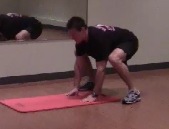
Here is a great way to start your Thanksgiving morning (or any morning). This is a little workout that will burn some early morning calories, ignite your metabolism, and make room for some good Thanksgiving food. I always like to do some morning workout or fun run with the family on Holidays, I find that I feel better all day and don't eat as much. Please give this a try!
Try to do as many circuits as possible in 15 or 20 minutes. Remember to perform an active warm-up before you begin. (Click here for a good active Firefighter workout warm-up routine.) Do the suggested reps of each exercise then proceed to the next, rest as little as possible between exercises.
Burpees x 10 reps
Pull-ups or Body Rows x 10 reps
Prisoner Lunges x 5 reps per leg
Squat to Press (around 20% body weight) x 10 reps
Feet on Stability Ball (or bench) Push ups x 10 reps
Plank (hold) for 30 seconds
Repeat the circuit as many times as you can for the allotted time (15 or 20) minutes.
Click on the video below for more instructions...
To help you eat a healthy during the holidays try to incorporate these Holiday Eating Guidelines... -Always drink water, it will help fill your belly and aid in digestion -Load up on vegetables not desserts (or sugars) -Eat leaner proteins -Avoid seconds -Don't graze around the appetizer table -If you really overeat, consider fasting for 14-16 hours after
AND MOST IMPORTANTLY....Remember the true meaning of the Holidays, be safe, be happy and enjoy family and friends. On that note, Thank You for being a member of the FRF Nation, I wish you a Happy and Safe Thanksgiving (and Holiday) weekend.
I get a lot of emails asking for good workout options for the firehouse when on-shift. Working out on-shift is a major concern, you want to make sure you keep your body in good "fit for duty" condition but also want to make sure you have enough "left in the tank" to respond and perform in an actual response. Over the last couple of years I have toyed with various workouts on shift; high intensity, heavy lifting, stretching only, and even some yoga. I have found that interval workouts are not only the most effective but a great way to incorporate fireground movements (steps, crawls, sledges, drags, lifts, carries, and some core).
Here is an example of a "Sunday Funday" workout that I did with my crew.
Active Warm-up Perform 2 circuits. Set an interval timer for 35 seconds of movement with 5 seconds between to transition.
Chops
Step back twist and reach
Spidermans
On floor knees side to side
X-overs
Fireground Interval Circuit
After completing the 2 active warm-up circuits perform the below exercises in a circuit 4 times. I like to set the interval timer for 35 seconds of work with 25 seconds of rest. If you are just beginning intervals you may want to set the timer for 30 seconds of work with 30 seconds of rest.
Aerodyne (if you don't have an aerodyne you can use row machine or battling hoselines)
Weighted Jump Rope
Stair Crawling (bear crawl up the stairs then run back down)
Sledges on a tire (overhead and side sledges)
Core Exercise (plank, bird-dog)
Mountain Climbers (or burpees)
Perform this circuit 4x for a total of 24 minutes.
Total workout time with the active warm-up is approximately 33 minutes.
Feel free to interchange the circuits with your favorite active warm-up or fireground exercises (please let me know if you do).
I've had a lot of requests for workout options that can be performed at the station with minimal equipment. Here is an option I created for a firefighter/medic that has no equipment and only some stairs and a parking lot. This can be used as a cardio interval training workout day (for those following the 28-day Quickstart Program) and/or as a good workout to get the blood flowing. Give it a shot!
This is a re-post from one of my more popular fire house workouts. Try this great interval at the firehouse (or any house), it doesn't require a lot of equipment and is very short in duration yet effective. The work intervals can be adjusted to your level of fitness. Beginners should perform 20 seconds of work followed by 40 seconds of rest for each exercise. Intermediates should perform 30 seconds of work followed by 30 seconds of rest and advanced (Firefit) athletes should perform 40 seconds of work followed by 20 seconds of rest for each exercise.
Click on the Video Above
Warm-up for 3 minutes with a walk or stairs then do: Mountain climbers Jumping Jacks Run in place or jump rope Burpees Prisoner Squats Side to Side (jumps or steps)
Beginners should repeat 1 more time (2x total) Intermediates repeat 2 more times (3x total) Advanced repeat 3 more times (4x total)
Cool down with 3 minutes of easy walking after you complete your circuits.
Have you heard of Tabata? This is an unusual style workout floating around a lot of gyms and firehouses lately. I wanted to explain what it is and how we, as fire rescue athletes, can incorporate it into an effective workout.
“Tabata” is the name of a particular type of workout program that provides increased fat burning and oxygen efficiency in a short period of time. Instead of hours upon hours of exercise, Tabata can be completed in just 4minute cycles.
Tabata training was developed by a Japanese researcher named Dr. Izumi Tabata who was working with Olympic speed skaters. In his study, he found that a control group using his training method of 20 seconds work, 10 seconds rest, for eight intervals, saw greater VO2 Max improvement than the other group that trained with 60 minute sessions. The real question that you want to know is: "How can this apply to fire rescue athletes instead of Olympic speed skaters?
We know that there are few activities more physically demanding than fighting a working fire or carrying a patient down and around stairs. In many cases fire rescue athletes are asked to work at near maximal heart rate and strength under very extreme and stressful conditions. This is the reason why high intensity training like Tabata should be included as part of our fitness program.
If you have followed my posts in the past you know how I believe that intervals have a huge place in the fire rescue athletes workout. You can read that post by clicking here.
.
So what is the Tabata protocol? A Tabata workout is an interval training cycle of 20 seconds at maximum effort, followed by 10 seconds of rest. The cycle is repeated without pause 8 times for a total of four minutes. Try to use this protocol at the end of a strength workout as a substitute to the 10-minute Interval Overhaul.
Gotta Love Burpees!
Tabata Protocol Interval Overhaul-- Choose 2 different exercises and switch between them every 20 seconds with 10 seconds of rest between. If you want to focus on more cardio recovery you can perform mountain climbers and burpees or row machine and treadmill. You can also use fireground movements and switch between them like sledges, drags, stairs or battling hoselines
Cardio Tabata Overhaul Option
20 seconds mountain climbers
10 seconds rest
20 seconds burpees
10 seconds rest
Repeat 3x (for a total of 4 rounds)
Fireground Tabata Overhaul Option
20 seconds sledge hammers (on tire or other)
10 seconds rest
20 seconds stairs or dummy drags/ farmers carry
10 seconds rest
Repeat 3x (for a total of 4 rounds)
**The original Tabata protocol was done on a bicycle and performed at a very high intensity. Try to perform the 20 second work intervals with as high intensity as you possibly can.
You can also use this protocol with strength and core exercises, stay tuned for a full body Tabata workout for firefighters (coming soon).
Now everyone loves predictions and I'm no stranger. After over 20 years in the fitness industry, I've seen my fair share of trends (remember leg warmers and step aerobics...).Well, this year I'm going to put my experience to work and create some predictions. Take a look!
2014 Fitness Prediction #1 – Shorter, High Intensity Workouts Will Dominate.
This year, your workout is going to get a lot more intense...or at least it should. High-intensity interval training is poised to hit the mainstream in 2014, according to a new survey from the American College of Sports Medicine.High intensity interval training, or HIIT, refers to workouts in which bouts of intense exercise are alternated with bouts of either rest of low-intensity activity.HIITresults in more fat loss than long, slow exercises like jogging, some studies have shown, and it's beneficial for your heart, too. But the best part: It's the most efficient workout around. For those of you that have followed Fire Rescue Fitness, you know I've been preaching and creating these workouts for a long time. I personally think that HIIT is one of the best workouts for firefighters but, you have to work your way up to it. If you haven't been regularly exercising, keep it slow to start. You'll also here a lot more about workout finishers (like my interval overhauls) and tabata style workouts.
2014 Fitness Prediction #2 – Paleo & Intermittent Fasting Will Be the Diet rages.
Currently, some of the most searched health & wellness phrases are Paleo, Vegan, Weight Watchers, and the 5:2 fasting program. Also, if you look at the most searched terms for diets in Google, you'll find that Paleo and Intermittent Fasting are pretty much #1 and #2 trending. My prediction is that we will see these search terms dominate in 2014. Honestly, I follow a modified Paleo diet and occasionally do some fasting. I love both and use both in varying ways because it keeps "eating" (not dieting) simple and easy to understand. Also, the quickest way I know to get anyone to lose weight and body fat is to have them follow "modified" Paleo and/or a 16-8 intermittent fasting regimen. Its an effective way to eat because it limits calories and focuses on eating real foods.
Speaking of an easy way to eat...check out and get my Standard Operating Procedures for Eating Healthy in the Firehouse.
Prediction #3 Dynamic Warm Ups, and Self-Myofascial release will be THE way everyone in the gym starts their workouts.
Gone are the days of starting your workout with a light jog coupled with
long (ineffective) stretches. Research proves that these types of warms ups do
nothing for the body and can increase your propensity for injury. Almost all of the gyms here (and now firehouses) in Madison have foam rollers available.
Effective programs must include an Active warm-up and flexibility training. The warm-ups prepare the body for movement, boosts heart rate, blood flow to the muscles, and core temperature. These movements also improve the function of your nervous system. Think of this component as taking a few minutes to warm-up a car that has been sitting outside in cold temperatures all night. The main goal of this the active warm-up and flexibility component is to improve the long-term mobility and flexibility of your muscles. The more flexible the muscle and joint around the muscle; the better the fire rescue athlete recovers and the less chance of injury. Here is an article that talks about this subject.
Fitness Prediction #4 - Transformation and Fitness Challenge Programs Will Be On The Rise
The first transformation program that made a real impact in the fitness industry was Bill Phillips body for Life Challenges. Since then, the transformation angle has lost some luster but that will change this year. It seems now that there are a lot of different fitness-related companies sponsoring these type of competitions. Personally, my fire department union has sponsored a fitness challenge that has been highly successful. Last year we had over 33% of the department compete in the challenge and made a great stride in creating a more healthy culture around the firehouses. You can get an overview and rules of the contest from the Fitness Challenge website (Click Here). If you're interested in creating your own fitness challenge, I can help, email mewith questions.
Fitness Prediction #5 for 2014- Cross Fit Will Reach it's Breaking Point
The injuries are piling up and so is the frustration with Cross Fit. I think that Cross Fit has hit its peak. Don't get me wrong, Cross Fit has a lot of good components to it but lacks sound periodization and planning. I think it's time that people take a look at implementing the good aspects of Cross Fit and losing these negatives. I wrote an article about Cross Fit that lists the good and bad, you can read it HERE. Fire Rescue Athletes need to challenge themselves to improve their fitness but should emphasize conservative training over risking injury. I am a big advocate to training "hard" but safe. There are no exceptions and no excuses for bad form.
Time is always been and will always be the number one reason we miss workouts. As Fire Rescue Athletes, we work unusual hours and our workouts are often interrupted by calls. Lately I've been creating and testing some highly efficient cardio interval workouts on my bootcamp classes and crew. Today's blog will give you two of the more effective ones and teach you some ways to integrate them into your busy schedules and workouts.
The 5 Minutes of Hell Interval Challenge
I like to use this interval challenge at the end of workouts or bootcamp classes. It really challenges your body’s ability to recover while continuing to work at a high intensity, just like it is on the fire ground. All you need for this interval workout is a wall and a timer. You can check out a video overview of the 5 minutes of hell (click here) and/or read the instructions below:
Set the interval timer for 10, 30 second intervals (no rest). You will move from one exercise to the next without rest……just keep moving. The five exercises for the interval are mountain climbers, burpees, side to side shuffles, crawling and the wall sit (or the plank).
Start the interval timer and perform the first exercise (mountain climbers)as fast as you can for 30 seconds. After the first 30 seconds, switch to burpees for the next 30 seconds; continue to switch exercises every 30 seconds. After you perform the wall sit (or plank) repeat a second time. You do not get to rest between exercises; just go from one to the next every 30 seconds until the 5 minutes is up.
You can make this interval more challenging by adding more difficult exercises (squat jumps, sledge hammers, body drags) or by adding more time for the intervals (change from 30 to 45 seconds) or by wearing a weighted vest. Give this one a try...or try the "sprint challenge" below.
The 5 minute sprint challenge
All you need for this cardio interval is a stopwatch and 20 to 40 yards of open space. The goal of this interval is to gas you out and force your body to recover quickly. You can check out a video overview of the workout by clicking here and/or read below. Here’s what you do:
Measure out 25 to 40 feet, the longer the distance the more difficult the workout, mark the distance with a cone or water bottle (any object will do). Personally, I measure out about 30-35 yards (or the distance of the Firehouse truck bay).
Start the stop watch and sprint down to the object, touch it and sprint back. Take a look at the time and rest until the stop watch reads 30 seconds, then sprint again. Repeat this every 30 seconds for 5 minutes.
You should sprint 2x per minute and 10 times total. The faster you run, the more rest you get (if it takes your 9 seconds to sprint down and back then you get 21 seconds to rest). Repeat a total of 10 times (5 minutes total).
You can make this more challenging by doubling the total time to 10 minutes (20 sprints), increasing the distance or adding a weighted vest. Enjoy this one, it sure gassed me.
Let me know what you think of these workouts or ways that you integrated them into your workouts.
Cardiovascular fitness is obviously a very important concern for the fire rescue athlete (firefighters, paramedics and EMTs). Lately I've been researching, creating then performing a lot of 10-minute interval overhauls and wanted to share them with you today. You can do one of these separately after a strength workout or combine all three for a good cardiovascular workout. These only take 10-minutes but you sweat (and burn calories) a lot longer than that. Give these a try.
1. The Uphill Grind. This is a great treadmill interval, if your just getting started with a fitness program (click HERE to get the FRF 28-day Quickstart Program) you want to decrease the speed and incline to a level that is a little more obtainable.
Start minutes 0-2 with a warm-up at 3.5mph and 3.5% incline next 30 seconds crank it up to 8.0 mph at 8.0% incline rest 30 seconds (I stand on the side rails of the treadmill) repeat 7 more times for a total of 10 minutes
**My goal is to be able to perform this interval with a weighted vest on....eventually.
2. Bottle Shock. This purpose of this interval is to help you control you breathing, like you were on air. You need to find area in your gym or firehouse where you can sprint for 10 yards. Once you've covered the distance, pause just long enough to inhale and exhale once through you nose. Sprint back and pause, this time inhaling and exhaling twice through your nose. Continue with the drill- breathing normally as you sprint and adding an additional nose inhalation and exhalation when you pause--until you can no longer breathe through your nose. At that point, rest 30 seconds then start over. Continue the exercise for 10 minutes total. You will be surprised how much more effort it takes to focus on your breathing.
3. The Cardio Pyramid. You can substitute any exercise you like as long as it gets your heart going. Personally, I like to do the first pyramid with jump rope, the second with mountain climbers and the third with stairs. Here is how it works, do as many reps as you can in 10 seconds then rest for an equal amount of time. Next do as many reps as you can in 20 seconds then rest 20 seconds. Then do 30 seconds of rest followed by 30 seconds of rest. Now work your way back down the pyramid with 20 seconds then 10. Once you finish the final 10 seconds rest, add another 30 seconds of rest and repeat again with the same exercise or a different one. You will perform a total of 3 pyramids (10, 10, 20, 20, 30, 30, 20, 20, 10, 10) with 30 seconds in between them for a total of 10 minutes. ENJOY this one.
Give these a try, please leave some comments about how you LOVE or HATE these intervals.
As a trainer (and as a firefighter in the workout room), I hear people saying, I want “abs” I want to help people achieve this. However, I frequently see people performing the least productive exercise for their abs. This is the crunch performed while lying down on a mat with the head and neck supported. This will not get you results. If you want to see the abs you feel during this exercise, change your diet! This is another topic. You cannot spot reduce.
The plank, for a modiefied (easier) version start on your knees
The crunch exercise will shorten and strengthen your rectus abdominus (six pack muscles) and obliques (especially if you twist) from a position that is useless for the majority of daily and sporting activities. Any exercise doesn’t totally isolate one muscle and has consequences for other muscles. The crunch exercise leaves you with weak neck muscles and shortened muscles of inspiration (breathing). You’re thinking, so what? I’m thinking poor posture that doesn’t look good, especially as one ages, greater tendencies for muscle tension headaches and whiplash due to an imbalance of torso strength to neck strength, and poor breathing.
So now you’re thinking but I read about doing crunch exercises in my favorite health or fitness magazine and it said it would strengthen my abs. It does, but it doesn’t teach them to perform. If you eat right, you will have a “dumb” beautiful muscle. But, your body knows nothing of muscles, only movements. This too is another topic. We all have a nervous system that communicates with our muscular system.
Our “abs”, or our torso (containing many muscles and nerve connections from the spinal cord) performs many functions. It flexes forward and back, to the side, as well as rotates or twists (especially on the fire ground and rescue scene), and primarily stabilizes the spine to provide an anchor for our limbs to produce force and hold us up against the forces of gravity. It does one or more of these functions simultaneously with the input from our nervous system. These ideas relate to the body knowing movements rather than muscles. Rarely, in daily activities or sport do the abs repeatedly flex a couple of inches off a flat surface. Therefore, it makes a lot of sense to teach the “abs” to stabilize rather than flex from the floor!
The “abs”, torso, or the “core” is a complex area to train. Yet, there are many exercises that can effectively train this area in a safe and functional manner. One of these exercises is the prone plank. This exercise (or a version of it) should be a staple in every firefighters, EMTs and Paramedics workout program. See how long you can hold the "correct" position--start with 30 seconds and work your way longer.
To perform the prone plank rest on your forearms or hold yourself up in a push-up position with your toes pulled up towards your shins and hold for as long as you can while maintaining the natural curves of your spine. The trick is not to allow your hips to either sag, shift, or twist to any side. Also, keep your neck in alignment. A common error during this exercise is letting the head drop towards the floor. This exercise teaches the abs to stabilize by performing an isometric (without movement) contraction that will enhance the posture, provide a lean elongated looking torso, and a foundation of strength for all sporting or daily movements.
Other forms of the Plank:
Performing the plank on a stability ball makes the core and shoulders work harder
To add more challenge to the core you can add "pulses" by lifting the hips. This exercise can be performed in reps instead of a static hold. Give it a try
Heres a video to demonstrate the Plank with pulses.
This movement along with other core movements should be a part of your workout program...don't have one, you can get one Here for FREE.
As a firefighter (paramedic and emt included), you train to mitigate the risks that you are sure to face on the job. Your fitness cannot be a liability, it must be on par with the skills you have spent so much time learning. Like an athlete, you must be game ready at all times. What does it mean to be game ready as a firefighter? To be ready, you must be training like a firefighter. I see too many firefighters training like bodybuilders or like the athletes that they may have been in high school or college. You can't train like a triathlete to play football nor train like a football player to play hockey. Training like a firefighter requires that you train in a way to specifically address the physical requirements of the job. That means working to acquire extreme levels of cardio vascular, muscular and metabolic endurance. You need the ability to go full throttle for 30, 40 or 60 minutes. You need to be able to recover quickly so that you can get back in the game. Some water, a new bottle of air and you are good to go. You also MUST have as strong core and good flexibility. With all this in mind let me ask you: "Are you training like a firefighter?" This website is dedicated to helping you not only train like a firefighter, get you Fit for Duty, stay Fit for Duty, and become a fire athlete.