Showing posts with label fire rescue fit. Show all posts

Monday, May 12, 2014

Firefighter Workouts on Shift-- To workout or not?

Do you workout on shift?  Should you workout on shift and what is the best workout to perform?

This is a major concern for the fire rescue athlete.  On one hand we know we should be working out to stay and get fit for duty. Yet , if we burn out in the gym we won't be able to perform when it really matters. I recently posted an interval workout (Click Here to Read it) that received a lot of hits and emails. Most of the emails dealt with this question more importantly asked "what is the best form of exercise to perform on duty?"

Here is my take on the question.  We all know that when the bell goes off the fire rescue athlete MUST be ready to perform.  With that in mind, it doesn't make a lot of sense to perform a grueling workout on duty.   I personally prefer some lighter cardio interval training, some core and/or rehab exercisesfoam rolling, and stretching.

One of the benefits of being a firefighter is that (for the most part) we know our schedules well in advance and should plan our more intense workouts for off-duty days and save the on-duty days to recover from them.   This requires some planning but is the most effective way to be "fit for duty."

Here is a great example of a "planned"  week of workouts for the fire rescue athlete.  This is similar to the weekly schedule found in the FRF Ultimate Fire Rescue Athlete Program.

Sunday
Fullbody Strength or Metabolic Workout- This type of workout challenges all muscle groups including the core.  Metabolic workout has short intervals and more power movements, strength workouts utilize longer rest intervals and heavier resistances.

Monday
Cardiovascular Interval Training-  Higher intensity cardio workout like sprints, hills or FRF Interval

Tuesday
Firehouse Shift- Foam rolling and light stretching between calls

Wednesday
Fullbody Strength or Metabolic Workout- This type of workout challenges all muscle groups including the core. Metabolic workout has short intervals and more power movements, strength workouts utilize longer rest intervals and heavier resistances.

Thursday
Firehouse Shift- Recovery day, maybe some foam rolling and/or stretching

Friday
Day OFF- This is a great day to take a day off, especially if you had a tough shift the night before

Saturday
Firehouse Shift- Cardio Interval and foam rolling, possibly some fire-ground circuits.

Sunday
Fullbody Strength or Metabolic Workout- This type of workout challenges all muscle groups including the core. Metabolic workout has short intervals and more power movements, strength workouts utilize longer rest intervals and heavier resistances.

Obviously everyone's schedule is a little different, I included the following Sunday to set up the next week where you may not have as many shifts.  The main idea is to plan your workouts to help you continue to work towards your fitness goal and to "be ready" on-shift.

If you are currently spinning your wheels about your workout plan or are looking for a new plan?  Take a look at the FRF Ultimate Fire Athlete Workout...I think it is the most efficient and effective workout for fire rescue athletes.

Please leave some comments and as always email me with questions. 
Stay Safe and Healthy,
A. Zamzow

Tuesday, March 18, 2014

Tabata Workouts for Firefighters

Have you heard of Tabata?  This is an unusual style workout floating around a lot of gyms and firehouses lately.  I wanted to explain what it is and  how we, as fire rescue athletes, can incorporate it into an effective workout.

“Tabata” is the name of a particular type of workout program that provides increased fat burning and oxygen efficiency in a short period of time.   Instead of hours upon hours of exercise, Tabata can be completed in just 4minute cycles.

Tabata training was developed by a Japanese researcher named Dr. Izumi Tabata who was working with Olympic speed skaters.  In his study, he found that a control group using his training method of 20 seconds work, 10 seconds rest, for eight intervals, saw greater VO2 Max improvement than the other group that trained with 60 minute sessions.  The real question that you want to know is:  "How can this apply to fire rescue athletes instead of Olympic speed skaters? 

We know  that there are few activities more physically demanding than fighting a working fire or carrying a patient down and around stairs.  In many cases fire rescue athletes are asked to work at near maximal heart rate and strength under very extreme and stressful conditions.  This is  the reason why high intensity training  like Tabata should be included as part of our fitness program. 

If you have followed my posts in the past you know how I believe that intervals have a huge place in the fire rescue athletes workout.  You can read that post by clicking here.   
So what is the Tabata protocol?   A Tabata workout is an interval training cycle of 20 seconds at maximum effort, followed by 10 seconds of rest.  The cycle is repeated without pause 8 times for a total of four minutes.   Try to use this protocol at the end of a strength workout as a substitute to the 10-minute Interval Overhaul. 

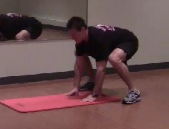
Gotta Love Burpees!
Tabata Protocol Interval Overhaul-- Choose 2 different exercises and switch between them every 20 seconds with 10 seconds of rest between.  If you want to focus on more cardio recovery you can perform mountain climbers and burpees or row machine and treadmill.  You can also use fireground movements and switch between them like sledges, drags, stairs or battling hoselines

Cardio Tabata Overhaul Option

20 seconds mountain climbers
10 seconds rest
20 seconds burpees
10 seconds rest
Repeat 3x (for a total of 4 rounds)

Fireground Tabata Overhaul Option
20 seconds sledge hammers (on tire or other)
10 seconds rest
20 seconds stairs or dummy drags/ farmers carry
10 seconds rest
Repeat 3x (for a total of 4 rounds)

**The original Tabata protocol was done on a bicycle and performed at a very high intensity.  Try to perform the 20 second work intervals with as high intensity as you possibly can. 


You can also use this protocol with strength and core exercises, stay tuned for a full body Tabata workout for firefighters (coming soon).