Showing posts with label firefighters. Show all posts

Monday, May 12, 2014

Firefighter Workouts on Shift-- To workout or not?

Do you workout on shift?  Should you workout on shift and what is the best workout to perform?

This is a major concern for the fire rescue athlete.  On one hand we know we should be working out to stay and get fit for duty. Yet , if we burn out in the gym we won't be able to perform when it really matters. I recently posted an interval workout (Click Here to Read it) that received a lot of hits and emails. Most of the emails dealt with this question more importantly asked "what is the best form of exercise to perform on duty?"

Here is my take on the question.  We all know that when the bell goes off the fire rescue athlete MUST be ready to perform.  With that in mind, it doesn't make a lot of sense to perform a grueling workout on duty.   I personally prefer some lighter cardio interval training, some core and/or rehab exercises, foam rolling, and stretching.

One of the benefits of being a firefighter is that (for the most part) we know our schedules well in advance and should plan our more intense workouts for off-duty days and save the on-duty days to recover from them.   This requires some planning but is the most effective way to be "fit for duty."

Here is a great example of a "planned"  week of workouts for the fire rescue athlete.  This is similar to the weekly schedule found in the FRF Ultimate Fire Rescue Athlete Program.

Sunday
Fullbody Strength or Metabolic Workout- This type of workout challenges all muscle groups including the core.  Metabolic workout has short intervals and more power movements, strength workouts utilize longer rest intervals and heavier resistances.

Monday
Cardiovascular Interval Training-  Higher intensity cardio workout like sprints, hills or FRF Interval

Tuesday
Firehouse Shift- Foam rolling and light stretching between calls

Wednesday
Fullbody Strength or Metabolic Workout- This type of workout challenges all muscle groups including the core. Metabolic workout has short intervals and more power movements, strength workouts utilize longer rest intervals and heavier resistances.

Thursday
Firehouse Shift- Recovery day, maybe some foam rolling and/or stretching

Friday
Day OFF- This is a great day to take a day off, especially if you had a tough shift the night before

Saturday
Firehouse Shift- Cardio Interval and foam rolling, possibly some fire-ground circuits.

Sunday
Fullbody Strength or Metabolic Workout- This type of workout challenges all muscle groups including the core. Metabolic workout has short intervals and more power movements, strength workouts utilize longer rest intervals and heavier resistances.

Obviously everyone's schedule is a little different, I included the following Sunday to set up the next week where you may not have as many shifts.  The main idea is to plan your workouts to help you continue to work towards your fitness goal and to "be ready" on-shift.

If you are currently spinning your wheels about your workout plan or are looking for a new plan?  Take a look at the FRF Ultimate Fire Athlete Workout...I think it is the most efficient and effective workout for fire rescue athletes.

Please leave some comments and as always email me with questions. 
Stay Safe and Healthy,
A. Zamzow

Friday, December 6, 2013

Firefighter Fitness- Is CrossFit it?

After reading the comments and getting responses to my posts about p90X, I decided it would be a perfect time to dissect the CrossFit fad that is popular in firehouses around the country.  I've worked in the fitness industry for over 20 years and have seen a lot of "fads" come and go.  Not to age myself but when I started in the industry step classes, leotards and zubaz where still popular.  Back in the day every health club focused on having the most updated machinery possible, today you see more minimalistic gyms pop up all the time.  Along with these fads have come the "next" best workout program.  I remember the day when everyone was "Jazzersizing" or "Sweating to the Oldies" or following the "Body for Life," program.  There were also the days of "Tae-bo", "Spinning" and who could forget "Fitness made simple"?   Some of these fitness fads have come and gone while others are still around.

The purpose of this blog is not to judge whether or not CrossFit is right for firefighters (although the title leads you to believe that) but to list the pros and cons of CrossFit to help you decide for yourself.  (On a side note, in the following weeks I will be discussing my personal views on this topic, so stay tuned).  

Defining CrossFit


According to CrossFit’s Foundations page, their program is designed to “optimize physical competence in each of ten recognized fitness domains,” which are: cardiovascular and respiratory endurance, stamina, strength, flexibility, power, speed, coordination, agility, balance, and accuracy.   The CrossFit program is designed for universal scalability making it the perfect application for any committed individual regardless of experience. They claim to use the same routines for elderly individuals with heart disease and cage fighters one month out from televised bouts. They scale the load and intensity, not change the programs. CrossFit specializes in not specializing.
The Pros of CrossFit.
High Intensity- More and more research studies are showing that short bursts of high intensity exercise is better for you than the typical hour or more long workouts at moderate intensity. CrossFit is all about this.

Muscle Confusion- The fact that the workouts vary so greatly from day to day means the body is always guessing and never has the chance to settle into that "workout groove" where it knows what's coming.  CrossFit focuses on maximal strength, muscular endurance, and cardiovascular efficiency all very important components to firefighters.


Timed, Efficient Workouts- Most CrossFit workouts are timed, which usually makes the exerciser push themselves harder, hopefully resulting in faster and better results. Plus, moving quickly in between sets keeps the heart rate elevated, burns more calories and helps improve recovery time.


Workouts Focus on Compound Movements and Olympic Style Lifting - This is great because it's how people get the most bang for their buck with their exercise. The more major muscles you use in a given movement, the calories you'll burn. Period.


Embrace Competition - This may be a "con" for some but the ideas here is that you should compete with yourself to constantly improve.   I also believe that the competitive environment of CrossFit may bring out greater performances in people.


Comradery-  This may also be a con for some.  If you are working out at a CrossFit gym you will be paired up with people during some exercises. You are in a class environment, which leaves plenty of room to meet and interact with new people that share a similar interest and goal.


I know that this is not a complete list of pros for CrossFit, please comment below and let me know what I've missed.  


So now that you have seen the pros, lets look at the other side of things (read these carefully).

The Cons of CrossFit for firefighter fitness.

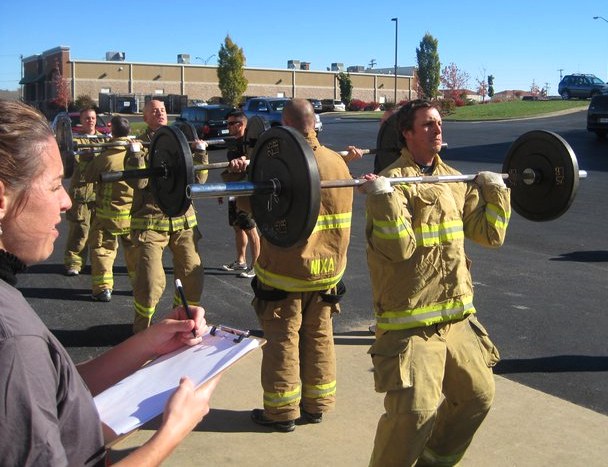
The use/misuse of Olympic lifts - One of the CrossFit Foundations places a heavy emphasis on Olympic Weightlifting because of their unique ability to develop an athletes’ explosive power, control of external objects, and mastery of critical motor recruitment patterns. And yet, the workout for June 29, 2011 included a set of 50 push presses. This is a little contradicting to the above statment. You do 50 reps for endurance, but the point that CrossFit makes is that Olympic lifting should be explosive power. Olympic lifts can also be fairly complex, so if the goal (which it is of CrossFit) is to get in, get sweaty, and get out, how much time do you think is dedicated to instruction in proper technique? They just tell people to perform potentially dangerous exercises as fast as they can as many times as they can and if they puke they can get a Pukey the Clown t-shirt (not kidding about the t-shirts).

Seemingly random programming– The workouts of the day bounce around in a seemingly random fashion. Per strength coach Alwyn Cosgrove: “Another one was 30 muscle-ups. And if you can’t do muscle-ups, do 120 pull-ups and 120 dips. It’s just random; it makes no physiological sense. Two days later the program was five sets of five in the push jerk with max loads. That’s not looking too healthy for the shoulder joint if you just did 120 dips 48 hours ago....hello injury.


Lack of Progression– Due to the never repeating nature of the WOD (workout of the day) programming, it is difficult, if not impossible to track progress in major lifts. How do I know my strength or speed is improving if I never repeat a protocol? Most strength coaches and trainers agree that some form of measurable progressive overload is crucial. If you are constantly confusing muscles, they don't learn how to adapt.


Difficult to Personalize--CrossFit claims its workouts are highly personalize-able, the resources for people unable to perform the standard WOD are slim. In fact, the Crossfit FAQ explicitly states that only those with “exposure to Olympic weightlifting, powerlifting, and gymnastics” should attempt the WOD right away. They claim to cater to "all fitness levels" but only the ones that have experience. No single workout of the day could possibly address the needs of all (or even most) people effectively or safely.


Overall CrossFit Program is Not Balanced - I know that there are some CrossFit die-hards out there that will insist it is. The reason why it is so important to train the muscles of the body in a balanced way is mainly to prevent injury. Another plus with balanced muscular training is symmetry and proper posture. This cons ties in with the random programming, because the workouts are "random" there is no way to insure that muscle groups are being challenged in a balanced manner. Injuries most often occur as a result of a muscular imbalance in a part of the body that is being called upon to produce great force. The "weak link" gives. That's why sports trainers pay great attention to training the opposing muscles of an athlete's main movement.


High Risk of Injury - The job or a trainer is to keep the risk of injury as low as possible while achieving the greatest gains possible. This is a constant balancing act. It may not matter how good a CrossFit is, they can't stay on top of everyone's technique and form. Plus, different people have different issues that get in the way of proper form.

CrossFit Certification--Someone with no training background and experience can do a weekend CrossFit certification and suddenly be "qualified" to develop and put people through workouts. You may be able to say that for some personal training certifications also but I don't think those certifications preach the high use of Olympic Lifting techniques.


Technique is often sacrificed- Competing to achieve personal records in number of reps or load at any cost can sometimes kick proper mechanics out the door. CrossFit preaches on constantly improving yourself well if you did one exercise for 7 good reps and one bad one, the next time your apt to do 7 good reps and two bad ones.


This is not an all-encompassing list of the pros and cons of the program, I know that I missed some. I'm not going to get into whether or not I find it valuable for all firefighters...that post will come shortly. For now, absorb these pros and cons and of course make some comments. I welcome all comments and emails with open arms and an open mind.


If you have not signed up for my subscriber list....you are missing out.  Sign up today and receive my **FREE 28-day FRF Quickstart Program and the SOP's to Eating Lean in the Firehouse.  Subscribers also receive special offers and workouts, YOU can sign-up HERE.


Stay safe and remember to "Train like a life depends on it."

To get some great workouts for Firefighters, EMTs and Paramedics, along with the SOPs to Eating Lean in the Firehouse join my VIP email list.


**Try the FireRescue Fitness 28-day Quickstart Workout for Free…and get the Standard Operating Procedure for Eating Lean in the Firehouse. Simply enter your name and email address below and the FREE reports will be instantly emailed to you. Inside, you’ll discover:The essential elements of an effective Firefighter workout program 

How to eat lean in the firehouse

Healthy Recipes for you and your Crew 

And a free subscription to my weekly FireRescue Fitness email newsletter where I’ll share with you creative and effective workouts and exercises along with nutritional advice to help you get and stay "Fit for Duty."