Showing posts with label firefighter core fitness. Show all posts

Wednesday, March 14, 2012

Firefighter Fitness-- Is CrossFit it?

I've worked in the fitness industry for over 20 years and have seen a lot of "fads" come and go.  Not to age myself but when I started in the industry step classes, leotards and zubaz where still popular.  Back in the day every health club focused on having the most updated machinery possible, today you see more minimalistic gyms pop up all the time.  Along with these fads have come the "next" best workout program.  I remember the day when everyone was "Jazzersizing" or "Sweating to the Oldies" or following the "Body for Life," program.  There were also the days of "Tae-bo", "Spinning" and who could forget "Fitness made simple"?   Some of these fitness fads have come and gone while others are still around.


Today I wanted to talk about another fitness "fad" that has seemed to catch the attention of the firefighting and tactical communities.  Yep, you guessed it....CrossFit.  This will be the first of two blog posts that gives my thoughts on the pros and cons of CrossFit. The purpose of these blogs is not to judge whether or not CrossFit is right for firefighters (although the title leads you to believe that) but to list the pros and cons of CrossFit to help you decide for yourself.  (On a side note, in the following weeks I will be discussing my personal views on this topic, so stay tuned).  


Defining CrossFit
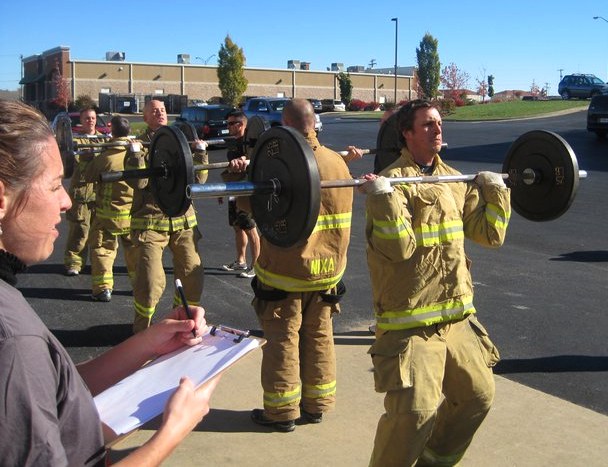

According to CrossFit’s Foundations page, their program is designed to “optimize physical competence in each of ten recognized fitness domains,” which are: cardiovascular and respiratory endurance, stamina, strength, flexibility, power, speed, coordination, agility, balance, and accuracy.   The CrossFit program is designed for universal scalability making it the perfect application for any committed individual regardless of experience. They claim to use the same routines for elderly individuals with heart disease and cage fighters one month out from televised bouts. They scale the load and intensity, not change the programs. CrossFit specializes in not specializing.
The Pros of CrossFit.
High Intensity- More and more research studies are showing that short bursts of high intensity exercise is better for you than the typical hour or more long workouts at moderate intensity. CrossFit is all about this.


Muscle Confusion- The fact that the workouts vary so greatly from day to day means the body is always guessing and never has the chance to settle into that "workout groove" where it knows what's coming.  CrossFit focuses on maximal strength, muscular endurance, and cardiovascular efficiency all very important components to firefighters.


Timed, Efficient Workouts- Most CrossFit workouts are timed, which usually makes the exerciser push themselves harder, hopefully resulting in faster and better results. Plus, moving quickly in between sets keeps the heart rate elevated, burns more calories and helps improve recovery time.


Workouts Focus on Compound Movements and Olympic Style Lifting - This is great because it's how people get the most bang for their buck with their exercise. The more major muscles you use in a given movement, the calories you'll burn. Period.


Embrace Competition - This may be a "con" for some but the ideas here is that you should compete with yourself to constantly improve.   I also believe that the competitive environment of CrossFit may bring out greater performances in people.


Comradery-  This may also be a con for some.  If you are working out at a CrossFit gym you will be paired up with people during some exercises. You are in a class environment, which leaves plenty of room to meet and interact with new people that share a similar interest and goal.


I know that this is not a complete list of pros for CrossFit, please comment below and let me know what I've missed.  Stay tuned, the next blog will be listing the  cons of CrossFit.
Stay safe and remember to train like a life depends on it.

If you have not signed up for my subscriber list....you are missing out.  Sign up today and receive my FREE 28-day FRF Quickstart Program and the SOP's to Eating Lean in the Firehouse.  Subscribers also receive special offers and workouts, YOU can sign-up HERE.

Friday, February 10, 2012

The Best Core Exercise for Firefighters, EMTs and Paramedics...

As a trainer (and as a firefighter in the workout room), I hear people saying, I want “abs” I want to help people achieve this. However, I frequently see people performing the least productive exercise for their abs. This is the crunch performed while lying down on a mat with the head and neck supported. This will not get you results. If you want to see the abs you feel during this exercise, change your diet! This is another topic. You cannot spot reduce.
The plank, for a modiefied (easier) version start on your knees
The crunch exercise will shorten and strengthen your rectus abdominus (six pack muscles) and obliques (especially if you twist) from a position that is useless for the majority of daily and sporting activities. Any exercise doesn’t totally isolate one muscle and has consequences for other muscles. The crunch exercise leaves you with weak neck muscles and shortened muscles of inspiration (breathing). You’re thinking, so what? I’m thinking poor posture that doesn’t look good, especially as one ages, greater tendencies for muscle tension headaches and whiplash due to an imbalance of torso strength to neck strength, and poor breathing.

So now you’re thinking but I read about doing crunch exercises in my favorite health or fitness magazine and it said it would strengthen my abs. It does, but it doesn’t teach them to perform. If you eat right, you will have a “dumb” beautiful muscle. But, your body knows nothing of muscles, only movements. This too is another topic. We all have a nervous system that communicates with our muscular system.
Our “abs”, or our torso (containing many muscles and nerve connections from the spinal cord) performs many functions. It flexes forward and back, to the side, as well as rotates or twists (especially on the fire ground and rescue scene), and primarily stabilizes the spine to provide an anchor for our limbs to produce force and hold us up against the forces of gravity. It does one or more of these functions simultaneously with the input from our nervous system. These ideas relate to the body knowing movements rather than muscles. Rarely, in daily activities or sport do the abs repeatedly flex a couple of inches off a flat surface. Therefore, it makes a lot of sense to teach the “abs” to stabilize rather than flex from the floor!
The “abs”, torso, or the “core” is a complex area to train. Yet, there are many exercises that can effectively train this area in a safe and functional manner. One of these exercises is the prone plank.  This exercise (or a version of it) should be a staple in every firefighters, EMTs and Paramedics workout program. See how long you can hold the "correct" position--start with 30 seconds and work your way longer.

To perform the prone plank rest on your forearms or hold yourself up in a push-up position with your toes pulled up towards your shins and hold for as long as you can while maintaining the natural curves of your spine. The trick is not to allow your hips to either sag, shift, or twist to any side. Also, keep your neck in alignment. A common error during this exercise is letting the head drop towards the floor. This exercise teaches the abs to stabilize by performing an isometric (without movement) contraction that will enhance the posture, provide a lean elongated looking torso, and a foundation of strength for all sporting or daily movements.

Other forms of the Plank:
Performing the plank on a stability ball  makes the core and shoulders work harder
To add more challenge to the core you can  add "pulses" by lifting the hips. This exercise can be performed in reps instead of a static hold.  Give it a try

Heres a video to demonstrate the Plank with pulses.
This movement along with other core movements should be a part of your workout program...don't have one, you can get one Here for FREE.


Sunday, January 22, 2012

Firefighter Fitness- Should You Exercise While Your Sick?


It’s that time of the year.  The flu bug is in full affect and is probably making its way through a firehouse near you.  We get exposed to lots of different viruses through EMS responses, hospital transports and via the close confines of the firehouse.  I get a lot of people asking me if they should try to exercise while they are battling the flu or the cold.
 According to the American College of Sports Medicine, the general rule of thumb is that if your symptoms are from the neck up; then “yes” give your workout a go.  If your symptoms are below; then “no.” 

Here’s what I mean:

If you have a common cold, runny nose, sore throat, and/or NO fever, then light to moderate exercise is generally “ok.”

If your illness involves body aches, fever, diarrhea, weakness, swollen lymph nodes, and/ or fatigue then it's best to “REST.”

Recommendations to help you get through a workout when you have a cold:

·         Hydrate!  Shoot for half your body weight in ounces of water per day
·         Stretch: increases circulation
·         Light cardio: Cardiovascular exercise causes vasodilatation or widening of the blood vessels to help clear up sinuses and cold symptoms.
·         Slow down: Decrease intensity & duration
·         Germs: Bring your own towel and water bottle and keep your germs to yourself!

Here are some tips to prevent getting the cold or flu:

·         WASH YOUR HANDS!  Keeping hands clean through improved hand hygiene is one of the most important steps we can take to avoid getting sick and spreading germs to others.
·         Rest! Sleep as much as possible to allow the body to recover!
·         Increase antioxidants: load up on fruits and vegetables; focus on Vitamins A, C, E and Selenium
·         Cut sugar & caffeine: Both have been shown to weaken the immune system
·         Eliminate alcohol: I’m not saying to quit, I’m just saying alcohol weakens the immune system. 

The bottom line is that you must “listen” to your body.   Personally, if I'm not feeling too bad, then I like to get a light cardio workout in to increase blood flow and circulation. If I choose to do strength work, I perform a low intensity workout to prevent too much muscle/body breakdown.
Hope these help.

Stay Safe!

Saturday, December 17, 2011

The Importance of a Strong Core for Firefighters, EMTs and Paramedics

Each year, tens of thousands of Firefighters, EMTs and Paramedics are injured while fighting fires, responding to incidents, transporting patients and training for the job. While a majority of the injuries are minor, a significant number are debilitating and career-ending.  Of these debilitating injuries almost 50% have to do with low back pain and a recent survey by the International Association of Fire Fighters determined that about half of all injury retirements were due to back injuries.  The high rate of low back injuries can be attributed to the high-risk activities that we are expected to perform, such as operating charged hoselines, climbing ladders, breaking windows, ventilating structures, performing overhaul and lifting objects greater than 40 lbs.  As you know, these tasks are often accomplished while the body’s posture is ergonomically unsound or on unstable ground.

I know I’m not telling you something you don’t already know, but I do want to emphasize the fact that over 50% of all injury retirements are due to low back pain.  Like you, I love my job and would hate to lose it because of injury.  Unlike other professions, we as Firefighters, EMTs and Paramedics don’t always have the luxury or the time to take precautions beforehand to minimize workplace injuries.  Let’s face it; we don't have the luxury of warming up at three in the morning when we go out on a scene. 
With that in mind you MUST keep your back and your core strong.  Take a look at the video below; here are 4 exercises that you should incorporate into your current fitness program.  Don’t have a fitness program, try them anyways…your career may depend on it.  (And, stay tuned for the Ultimate Workout Program for Firefighters, EMTs and Paramedics…coming soon)


Try to incorporate these 4 exercises (1 or 2 circuits 10 to 20 reps)
1.  4-count crunch
2.  Plank
3.  Bicycle crunch
4.  Swimmers (opposite arm/leg raise)