I wanted to wish everyone a Happy and Healthy New Year!
I also wanted to thank all the members of the Fire Rescue Fitness Nation and to let you know I am committed to providing you with the best content, workouts and fitness programming.
Please continue to join me in 2013 and commit to getting/staying "Fit for Duty."
Stay Safe, Healthy and Happy in 2013
A. Zamzow
PS-- One of the new things for 2013 are more efficient workout formats, check out the NEW FORMAT (Click HERE) of the Post Holiday Workout and let me know your thoughts!
Showing posts with label components of fire fighter fitness. Show all posts
Monday, December 31, 2012
Saturday, December 22, 2012
A Great Post Holiday Metabolic Workout
Happy Holidays- Yes that time of the year where we have a tendency to overindulge and workouts seem to take second place to the holiday rush. To combat the accumulation of holiday pounds I created this Fire Rescue Metabolic Workout.. This workout requires minimal time, maximal effort and will give you an extreme calorie burn (throughout the day). Intermediate/ Advanced athletes should use weights that they can handle for 15 reps (even though you will only be performing 10 reps) while beginners will use body-weight for each exercise. Each rep should be performed with control (safety first) and good form. You must perform 2 circuits of the warm-up. After the warm-up follow the appropriate circuit (beginner or intermediate/ advanced) as quickly as possible. Your goal is to complete the entire circuit as quickly as possible. Remember to record your total time (of the metabolic circuit) so you can measure your fitness progress from workout to workout.
Holiday Metabolic Circuit
Perform the active warm-up exercises in a circuit, no rest between exercises; follow the suggested reps for each. Repeat the circuit 2x. Click HERE for a video overview of the warm-up.
Warm-up Exercises (reps)
- Prisoner Lunges (6x each side)
- Step forward Toe Touches (6x ea side)
- Chest hugs (20x)
- Waiters bow (6 each arm)
- Step Back, Reach Twist (6x each side)
- Spiderman’s (6 each side)
- Knees side to side (6 each side)
- Straight Leg Raises (6x each side)
- Hip Cross-overs (6x each side)
Repeat the warm-up circuit (total of 2x)
Metabolic Circuit
After the warm-up, perform the exercises in a circuit, rest as little as possible between exercises. Remember to take rest if you need it. The idea of the workout is to complete it as fast as possible (using good form) and try to improve your time each workout. The suggested reps are listed in parenthesis. Click on the video below for an overview of the exercise for the beginner circuit. Remember to record your total time (minus the active warm-up) and try to improve on it from workout to workout. Enjoy.
Beginner Exercises
- Push-ups (10x)
- Body Row (10x)
- Prisoner Squats (10x)
- Prone Plank Pulses (10x)
- Walking Lunges (10 each side)
- Bike 2 miles (as fast as possible)
Repeat the circuit again (for a total of 2x)
For an even greater calorie burn and challenge try the Intermediate/ Advanced Circuit. You must perform 2 circuits of the active warm up first.
Intermediate/ Advanced Exercises
Click on the video below for an overview of the exercises of the Intermediate/ Advanced circuit.
- Spider Push-ups (5 each leg)
- Pull-ups (10x)
- Squat to Press (10x)
- Weighted V-ups (10x)
- Prone Plank Pulses (marching 10 ea leg)
- Weighted Walking Lunges (10x each leg)
- Run 1 mile or bike 3 miles (as fast as possible)
Don't forget to record your times and try to improve from workout to workout.
Happy Holidays!
A. Zamzow
Tuesday, June 26, 2012
Are You Firefighter Fit?
A couple weeks ago I published a blog post about "defining Firefighter Fit." I appreciate the numerous responses and comments about this question (see that blog post here) and today want to follow up and add some more information and questions about this topic. One of the consensus opinions expressed when asked to define "firefighter fit" was that a firefighter needs to be physically ready for any situation whether it’s advancing a heavy hose line, lifting a patient onto the cot, forcing a door or dragging someone out of the building. My reply to that statement is "how can we test for these situations?" The CPAT? The CPAT was designed to do just that and from my experience it is a great test, challenging and applicable to the actions required on the fire ground. For those that don't know about the CPAT (read more here), it is a timed pass/fail standardized test that consists of eight separate events: · Stair Climb
· Hose Drag
· Equipment Carry
· Ladder Raise & Extension
· Forcible Entry
· Search
· Rescue
· Ceiling Breach &Pull
During the CPAT, you must progress along a predetermined path from one event to the next in a continuous manner. Participants wear a 50-pound (22.68-kg) vest to simulate the weight of self-contained breathing apparatus (SCBA) and firefighter protective clothing. An additional 25 pounds (11.34 kg), using two 12.5-pound (5.67-kg) weights that simulate a high-rise pack (hose bundle), is added to your shoulders for the stair climb event. You have 10 minutes and 20seconds to complete all eight tasks. As I mentioned above I find that it is a very challenging and applicable skill test for firefighters. The problem with the test is that it requires special equipment and lots of room. So, what are tests that can be administered in a regular gym or firehouse that are good assessors of firefighter fitness?
My research on this topic has found (please let me know your thoughts below) that there are 5 specific tests that can help indicate a firefighters level of fitness. Let it be known that these test do not test the skill level of the firefighter (raising ladders, search and rescue, forcible entry) but are a good correlation. I do intend to post about some good skill related courses soon, so stay tuned. These tests are the plank, push-up, mile run, overhead squat, and body composition. (As mentioned before please comment on whether you agree or not). Each one of these tests assess a valuable fitness component to firefighting (fire rescue athlete); the plank tests core strength, the push up- muscular endurance, overhead squat- functional fitness, the mile run- cardiovascular fitness, and body composition- overall health. Try each test and let me know your results. Are you Firefighter Fit? Or are there better ways to test firefighter fitness?
Plank (core stability)
You’ll need something long, solid, light, and straight, like a broom handle or dowel. Assume a basic plank position, with your weight resting on your forearms and toes. Your body should form a straight line from neck to ankles. You want your feet hip-width apart and your elbows directly below your shoulders. Have a friend set the dowel along your back. It should make contact at three points: the back of your head, between your shoulder blades, and your tailbone. Hold that position. Stop if your body loses contact with the dowel at one of these three points.
THE SCORECARD
Below average= You can’t hold a basic plank 60 seconds
Average= You go 60 seconds
Above average= You can hold a plank 60 seconds with your feet elevated on a bench
FireFit= You can hold a plank with your arms extended for 60 seconds
Overhead Squat (functional fitness)
As with the basic plank, you’ll need a broom handle or dowel for this test, the overhead squat. Stand in front of a mirror with your feet shoulder-width apart, holding the dowel straight above your shoulders with your hands wide (about 1½ times shoulder width) and your elbows locked. Push your hips back and lower yourself into a squat as you keep the dowel directly above your head, your knees over your toes, and your heels on the floor. Go down as far as you can without changing the position of your lower back, leaning forward, pulling your knees inward, or rising up on your toes. A word to the wise: This test is much harder to complete with perfect form than you think, so don’t take it lightly.
Below average= You can’t bend your knees 90 degrees without leaning forward
Average= You can bend your knees more than 90 degrees, but only if your heels come off the floor
Above average= You can do a full squat (top of your thighs parallel to the floor) with your heels on the floor and without leaning forward
Fire Fit= You can perform a perfect overhead squat with a 45-pound Olympic barbell
Push up test (muscular strength)
Assume a pushup position with your hands directly below your shoulders, your feet hip-width apart, your weight resting on your hands and toes, and your body in a straight line from neck to ankles. Lower your body until your chest is about an inch above the floor, pause for 1 second (this is essential), and then return to the starting position. Complete as many consecutive pushups as you can while maintaining strict form.THE SCORECARD
Below average= fewer than 15 pushups
Average= 16 to 29 pushups
Above average= 30 to 44 pushups
Fire Fit= 45+ pushups
Mile Run (endurance)
It’s best to test yourself outdoors on a track or flat stretch of trail or pavement where your distance can be accurately measured. If you choose to run on a treadmill, make sure you elevate it to 2 degrees to make up for the mechanical assistance you’re receiving from the moving belt. Once you’re sure of the distance, start your stopwatch and take off.
THE SCORECARD
Below average You need 12+ minutes to run a mile
Average 9 to 12 minutes
Above average 6 to 9 minutes
Fire Fit =You run a mile in under 6 minutes
Body Composition (overall health)
In physical fitness, body composition is used to describe the percentages of fat, bone and muscle in human bodies. Because muscular tissue takes up less space in our body than fat tissue, our body composition, as well as our weight, determines leanness. Two people at the same height and same body weight may look completely different from each other because they have a different body composition. Your body composition can directly affect your personal performance in activities of daily living as well as on the job. Certain body composition levels are strong indicators pointing to your risk level of certain physical diseases. There are many ways to determine body composition, I prefer to use the 3-site method, it's easy and a good indicator (read more about body composition testing here)
THE SCORECARD for MEN
Below average= 19-25% body fat
Above average= 13-18% body fat
Fire Fit = 12% body fat or below
THE SCORECARD for WOMEN
Below average= 26-31% body fat
Above average= 19-25% body fat
Fire Fit = 18% body fat or below
Give these tests a try and see how you measure up. If your having difficulties or don't score as high as you would like, JOIN the FireRescue Athlete Nation and get the FREE FRF 28-day Quickstart Workout program which includes the SOP's to Lean Eating in the Firehouse.
Please leave comments or send me an email with your thoughts about "Are YOU Firefighter Fit."
Stay Safe,
A. Zamzow
Sunday, May 20, 2012
How Do You Define Firefighter Fit?
Are You Firefighter Fit?
Most people, when asked this question, will normally think about how much weight they can lift or if the are overweight or not. I argue that being "firefighter fit (fire rescue fit) is much more than that. You may be able to lift heavy weights but that doesn't necessarily mean that you are that strong. When talking about Firefighter fitness you are only as strong as your "weakest" part. You see true strength comes in the form of functional fitness, fitness that can be applied and used in fireground situations, not just in a gym.
When you carry the saw from the truck to the scene or lift a patient into the ambulance you use many muscle groups which have to work together to achieve the job at hand. The Fire Rescue athletes' body must work as one unit, integrating all the muscles together. Weight training in its conventional form (on machines), isolates muscle groups, and it does not teach the muscles it isolates to work with each other.
Functional exercises focus on building a body capable of performing real life movements in real life positions, whereas weight training on machines in a gym, teaches the body to perform only in positions when posture is made ideal by the machine.
Machine training is not the same as functional training. We see this in the fire industry all the time, someone reaches for something or bends the wrong way and "bang," throws their back out. Now there are cases where we lift heavy things in awkward positions and "yes" those situations have a high incidence of injury. What I'm talking about are the situations where someone is reaching for something light and happens to "tweak" their back or shoulder. In this situation, the "tweak" can be attributed to poor core strength and a lack of flexibility. When we perform everyday movements, such as carrying equipment or reaching over a patient, our body calls into play many more muscles than would be used on a gym machine. When we lean over or reach to lift the equipment, we use the stabilising muscles, which include the core muscles of the abdomen and secondary muscles to keep our balance so we don’t fall over.
We all know that firefighting is a physical job, we need to be strong, have good muscular endurance, great core and grip strength and must be able to recover quickly. The challenge that we (as fire rescue athletes) face is trying to identify how to functionally test fire rescue athletes? There are so many components of the body that must work efficiently in order to do the everyday tasks of the Fire Rescue Athlete. This is the purpose of today's blog post. How do you define firefighter fit? What tests do you think are good measures for our job?
I have been doing a ton of research on this topic and have some guidelines and assessments that may work which I will post about soon. For now, what I really need is some input on this topic, let me know what you think. Please leave comments or email me.
Stay Safe,
A. Zamzow
PS- If your looking for a great firefighter workout program and some nutritional guidance please join my FireRescue Fitness Email list and get my 28-day Quickstart Workout Program and the SOP's to Eating Lean in the Firehouse. Click here to get them FREE.
Sunday, March 25, 2012
Firefighter Fitness-- Recruit Academy Fitness Programming
As firefighters we protect life and property by any means necessary. And by “any” we mean the “safest and the best.” This means we do not marry ourselves to any one response modality or school of thought. We don’t always go interior on a fire attack...or always use a Halligan to force open a door (sometimes it’s already unlocked) right? We take into account certain factors along with the environment, resources, etc. and make the best tactical decisions we can. Granted, we do have protocols and procedures to follow that help guide us along our process but we must be able to adapt and compromise.
Trainers, chiefs and officers should take this same approach to creating a fitness program for recruits. There is no “best” workout program for recruits, just as there is no “best” way to force a door. Going into a situation, a well prepared firefighter should have a plan in the back of their head but also must be able to adapt to changing conditions. To create an effective recruit fitness program, trainers, chiefs and officers must take into consideration the specific needs of the recruits and the demands of the fire academy. The goals of the recruit academy fitness program should be to 1) prepare the recruit for the demands of being a fire rescue athlete and 2) teach them how to utilize proper fitness modalities to prolong their career.
Let’s look at the first part of that goal. When a recruit finishes the academy they need to be ready for almost any event...strong enough to routinely carry, able to lift and drag loads of 50 to 100 pounds, have the balance to climb stairs and ladders, the power to swing heavy mallets and axes, and the muscular endurance to recover from these events quickly and be able to perform them for prolonged periods of time. Oh yes, I forgot to mention that they must be able to do all of these things in awkward positions and sometimes on unstable planes. OK, so maybe designing a program for the fire rescue athlete (recruit) is not so easy. But, by strategically using different training modalities in a planned progression, an effective fitness plan or “protocol” can be created. Before we begin to plan the recruit fitness program, it is essential that we talk about the concept of periodization. Periodization is the systematic application of overload through a preplanned variation of program components to optimize gains in strength and endurance while preventing overuse, staleness, over-training, injury and plateaus. While that sounds pretty technical, it basically means that periodization is a plan that is used to effectively and efficiently maximize fitness gains. Research has shown periodized programs are superior in eliciting fitness improvements.
The periodization model consists of various training periods or components. These components are distinct periods of time you are working with like the training session, week, and/or cycle. Identifying, defining and organizing these components allow the trainer to easily accomplish several things. First, organizing the components provides a developmental progression which keeps the training effective and safe. Second, the organization of these components keeps the training changing and interesting. Last, organizing the various components of periodization provides a direction to peak performance; this keeps the training optimal.
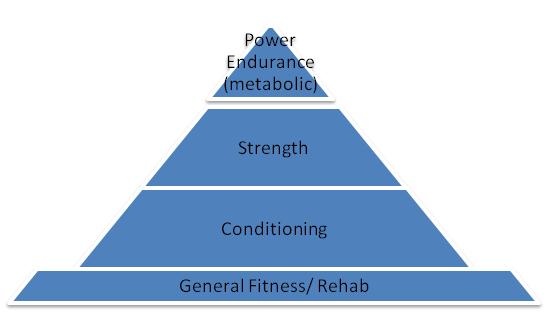
Training should follow a developmental approach. This means there should be a hierarchy of training. First it is essential for the athlete to develop a training base that should increase the body’s functional capacity. Once this is accomplished, the intensity of the exercise is increased to emphasize strength development. This period is characterized by lower volumes of work and higher intensities. In more general terms, we can also say we develop stability, then strength, and finally power. Regardless of what the training program looks like, it cannot violate this developmental approach. If the recruit’s joints aren’t stable, they cannot be heavily loaded. Likewise, if their muscles have not been conditioned, they cannot produce fast, high-intensity contractions (power). If this developmental approach is not followed, the likelihood of an injury and/or over training greatly increases.
The above pyramid represents the Hierarchy of Firefighter Fitness Development. Every recruit fitness program should begin in the general fitness or conditioning phase and progress throughout the academy. This same approach should be taken by active firefighters working to get and stay “fit for duty.”
The chart below provides details of each developmental phase. These guidelines should be used to help create an effective recruit fitness program.
By now I hope you understand that creating an effective firefighter fitness program is more than just using weight machines or following the newest fitness trend. To develop an effective periodization program for the fire athlete, it is essential to understand the overall structure of the program. Once that structure is clear, the process of incorporating rest, variety, and progression becomes more manageable. The key to successful periodization is the ability to challenge the body with new activities and progressive overload (intensity). Three to four week cycles will get results. Just as the body experiences peak benefits of one cycle of planned workouts and starts to adapt to it, the athlete moves into a whole new three to four-week cycle that offers a completely new set of challenges.
American college of Sprts Medicine (ACSM). (2000). ACSM’s Guidelines for Exercise Testing and Prescription (6th edition). Baltimore, MD: Lippincott, Williams &Wilkins.
IAFF/IAFC/ACE. (2006). Peer Fitness Trainer Reference Manual. Monterey, CA: Healthy Learning.
International Association of Fire Fighters (IAFF). (2000). The Fire Service Joint Labor Management Wellness-Fitness Initiative. Washington, DC: International Association of Fire Fighters.
Kraemer, W.J., Ratamess, N.A. and French, D.N. (2002). Resistance Training for Health and Performance. Curr. Sports Med. Rep. Vol. 1. Pp 165-171.
Santana, J.C. (2003). The Essence of Program Design (The Ultimate Guide for Trainers & Coaches). Boca Raton, FL: Institute of Human Performance.
Trainers, chiefs and officers should take this same approach to creating a fitness program for recruits. There is no “best” workout program for recruits, just as there is no “best” way to force a door. Going into a situation, a well prepared firefighter should have a plan in the back of their head but also must be able to adapt to changing conditions. To create an effective recruit fitness program, trainers, chiefs and officers must take into consideration the specific needs of the recruits and the demands of the fire academy. The goals of the recruit academy fitness program should be to 1) prepare the recruit for the demands of being a fire rescue athlete and 2) teach them how to utilize proper fitness modalities to prolong their career.
The periodization model consists of various training periods or components. These components are distinct periods of time you are working with like the training session, week, and/or cycle. Identifying, defining and organizing these components allow the trainer to easily accomplish several things. First, organizing the components provides a developmental progression which keeps the training effective and safe. Second, the organization of these components keeps the training changing and interesting. Last, organizing the various components of periodization provides a direction to peak performance; this keeps the training optimal.
Training should follow a developmental approach. This means there should be a hierarchy of training. First it is essential for the athlete to develop a training base that should increase the body’s functional capacity. Once this is accomplished, the intensity of the exercise is increased to emphasize strength development. This period is characterized by lower volumes of work and higher intensities. In more general terms, we can also say we develop stability, then strength, and finally power. Regardless of what the training program looks like, it cannot violate this developmental approach. If the recruit’s joints aren’t stable, they cannot be heavily loaded. Likewise, if their muscles have not been conditioned, they cannot produce fast, high-intensity contractions (power). If this developmental approach is not followed, the likelihood of an injury and/or over training greatly increases.
The above pyramid represents the Hierarchy of Firefighter Fitness Development. Every recruit fitness program should begin in the general fitness or conditioning phase and progress throughout the academy. This same approach should be taken by active firefighters working to get and stay “fit for duty.”
The chart below provides details of each developmental phase. These guidelines should be used to help create an effective recruit fitness program.
By now I hope you understand that creating an effective firefighter fitness program is more than just using weight machines or following the newest fitness trend. To develop an effective periodization program for the fire athlete, it is essential to understand the overall structure of the program. Once that structure is clear, the process of incorporating rest, variety, and progression becomes more manageable. The key to successful periodization is the ability to challenge the body with new activities and progressive overload (intensity). Three to four week cycles will get results. Just as the body experiences peak benefits of one cycle of planned workouts and starts to adapt to it, the athlete moves into a whole new three to four-week cycle that offers a completely new set of challenges.
References
American college of Sprts Medicine (ACSM). (2000). ACSM’s Guidelines for Exercise Testing and Prescription (6th edition). Baltimore, MD: Lippincott, Williams &Wilkins.
IAFF/IAFC/ACE. (2006). Peer Fitness Trainer Reference Manual. Monterey, CA: Healthy Learning.
International Association of Fire Fighters (IAFF). (2000). The Fire Service Joint Labor Management Wellness-Fitness Initiative. Washington, DC: International Association of Fire Fighters.
Kraemer, W.J., Ratamess, N.A. and French, D.N. (2002). Resistance Training for Health and Performance. Curr. Sports Med. Rep. Vol. 1. Pp 165-171.
Santana, J.C. (2003). The Essence of Program Design (The Ultimate Guide for Trainers & Coaches). Boca Raton, FL: Institute of Human Performance.
Monday, March 5, 2012
Components of a Firefighter Fitness Program
I often get asked by Firefighters, EMTs and Paramedics to evaluate their current fitness programs and to possibly give some suggestions. I try to explain to the individual or group that in order to evaluate the program we must understand the physical demands of the job.
In layman’s terms it means this...Firefighters need to be ready for almost any event. They need to routinely carry loads of 50 to 100 pounds, climb stairs and ladders, swing heavy mallets and axes, drag heavy objects, hold, hoist and stabilize hose lines. They must also be able to recover quickly from these tasks and perform such activities for prolonged periods of time. Lets not forget that all these actions are routinely done in awkward positions and sometimes on unstable planes.
If you look at the above demands, tops on that list would be the emphasis on cardiovascular conditioning and recovery, next would be core strength and endurance to be able to carry the heavy weights in awkward positions, then you look at overall muscular strength and muscular endurance, flexibility and recovery. So basically, we need a functional fitness program that emphasizes circuit training, core training, balance and agility, joint flexibility, overall strength and endurance and must do this progressively to insure proper form and injury prevention. Doesn’t sound like your routine fitness program now does it?
Source
Gledhill, N. and Jamnik, VK. (September, 1992). Characterization of the physical demands of firefighting. Can J Sport Sci. 17(3):207-13.
Research conducted by York University (Ontario) about the physical demands of Firefighting stated-- The most commonly encountered applications of strength and endurance were lifting and carrying objects (up to 80 lbs), pulling objects (up to 135 lbs), and working with objects in front of the body (up to 125 lbs). The most demanding firefighting operations required a mean VO2 of 41.5 ml/kg.min-1 with peak lactate concentrations of 6 to 13.2 mM. Ninety percent of the demanding firefighting operations that were studied required a mean VO2 of 23 ml/kg.min-1. These aerobic energy requirements corresponded to 85 and 50% VO2max, respectively. Therefore a minimum VO2max standard for firefighter applicants of 45 ml/kg.min-1 is recommended.
In layman’s terms it means this...Firefighters need to be ready for almost any event. They need to routinely carry loads of 50 to 100 pounds, climb stairs and ladders, swing heavy mallets and axes, drag heavy objects, hold, hoist and stabilize hose lines. They must also be able to recover quickly from these tasks and perform such activities for prolonged periods of time. Lets not forget that all these actions are routinely done in awkward positions and sometimes on unstable planes.
So how do you translate those demands into a fitness program?
If you look at the above demands, tops on that list would be the emphasis on cardiovascular conditioning and recovery, next would be core strength and endurance to be able to carry the heavy weights in awkward positions, then you look at overall muscular strength and muscular endurance, flexibility and recovery. So basically, we need a functional fitness program that emphasizes circuit training, core training, balance and agility, joint flexibility, overall strength and endurance and must do this progressively to insure proper form and injury prevention. Doesn’t sound like your routine fitness program now does it?
Are you currently working out or need a program to get you back on track? Download the FREE FireRescueFitness 28-day Quickstart Program and get "Fit for Duty."
Source
Gledhill, N. and Jamnik, VK. (September, 1992). Characterization of the physical demands of firefighting. Can J Sport Sci. 17(3):207-13.
Subscribe to:
Posts (Atom)